 SAIPAL PLANT PROFILER™
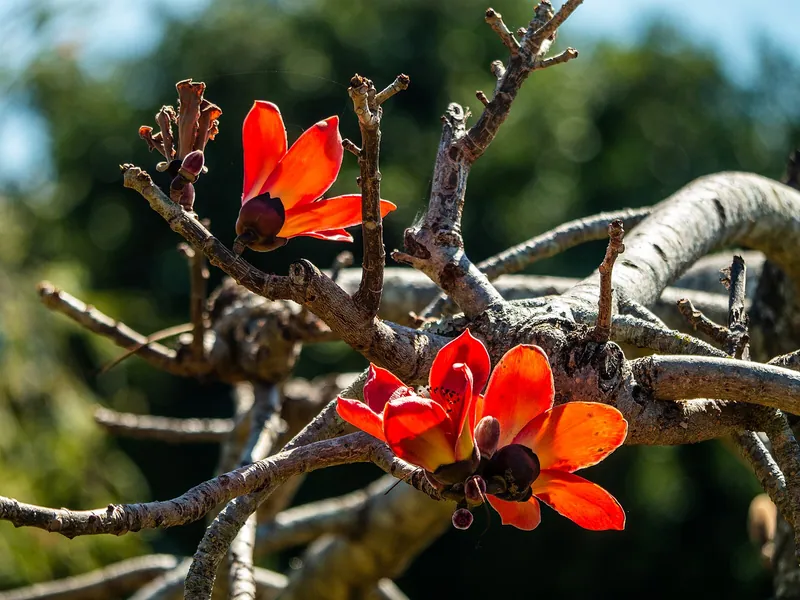

Red Silk Cotton Tree
Bombax ceiba
Also known as: Semal (Hindi) · Buruga (Telugu) · Ilavam (Tamil) · Kate sawar (Marathi)
Standard horticultural guidance
- ☀️SunFull sun
- 💧WaterLow water
- 🪴SpaceOpen ground
- ⭐CareEasy care
- 📅SeasonAll year
- 🛡️SafetyThorny
Red flowers full of nectar for birds; spiny trunk.
Plant profile
| Common name | Red Silk Cotton Tree |
|---|---|
| Botanical name | Bombax ceiba |
| Family | Malvaceae |
| Category | Trees › Flowering trees |
| Plant type | Bombax |
| Growth habit | Tree |
| Origin | Native to India – Tropical Asia and northern Australia |
| Sunlight | 6+ hours of direct sun |
| Watering | Check the soil first: water only when the top 5 cm (two finger joints) is dry. Young trees: soak deeply once or twice a week in summer and every 10–14 days in winter. Established trees need water only in long dry spells. |
| Soil | Grows in most soils, including poor soil, if drainage is good |
| Where it grows | Open ground (backyard / farm) |
| Pot or space needed | Open ground |
| Mature size | Tree – usually 20 ft (6 m) or taller |
| Propagation | Seeds |
| Flowering | Jan–Mar |
| Fruiting / harvest | Mar–May |
| Care difficulty | Easy |
| Child & pet safety | Thorny / spiny – keep away from play areas |
| Uses | Ornamental, birds, fibre |
| Best season | All year · best planted Jun–Aug or Oct–Nov |
Where in India it grows well
| Telangana and Rayalaseema | ✔ Grows well |
|---|---|
| Coastal Andhra Pradesh and Odisha | ✔ Grows well |
| Karnataka plateau (Bengaluru, Mysuru) | ✔ Grows well |
| Tamil Nadu plains | ✔ Grows well |
| Kerala and the Konkan–Malabar coast | ✔ Grows well |
| Maharashtra (Mumbai coast, Pune, Vidarbha) | ✔ Grows well |
| Delhi and the northern plains | ✔ Grows well |
| Hill stations (Ooty, Kodaikanal, Shimla, Darjeeling) | ✔ Grows well |
About this plant
Where it is grown: Found across South and Southeast Asia, southern China and northern Australia.
History: Its seed fibre has long been used to stuff pillows and mattresses.
Did you know? Its large red flowers hold so much nectar that many bird species feed on them.
Cold tolerance: Handles cool, dry winters.
Why grow it: A bird magnet with bold red flowers on bare branches.
Sources and review
- Standard horticultural guidance for Indian conditions – Compiled by SAIPAL from general practice published by ICAR institutes and state agricultural universities
- Plant photographs and taxonomy pages – Wikimedia Commons
Not yet reviewed by an outside expert. Content prepared by SAIPAL; corrections are welcome through the Feedback page.