 SAIPAL PLANT PROFILER™
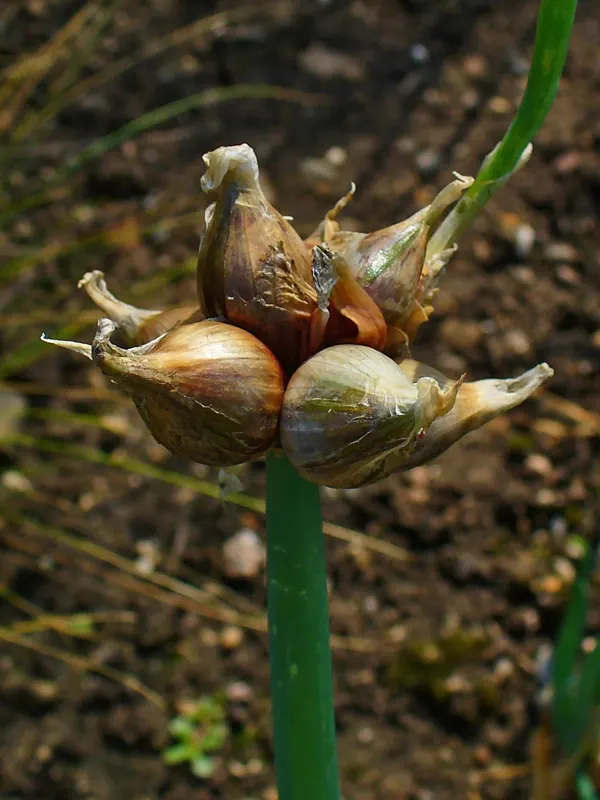

Onion
Allium cepa
Also known as: Pyaz (Hindi) · Ullipaya (Telugu) · Vengayam (Tamil) · Eerulli (Kannada) · Ulli (Malayalam) · Kanda (Marathi)
Standard horticultural guidance
- ☀️SunFull sun
- 💧WaterModerate water
- 🪴SpaceSmall pot
- ⭐CareEasy care
- 📅SeasonOct–Feb
- 🛡️SafetyChild & pet safe
Winter crop; bulbs in about 120 days.
Plant profile
| Common name | Onion |
|---|---|
| Botanical name | Allium cepa |
| Family | Amaryllidaceae |
| Category | Vegetables › Bulb and stem vegetables |
| Plant type | Onion |
| Growth habit | Herbaceous plant |
| Origin | Introduced to India – Central Asia |
| Sunlight | 6+ hours of direct sun |
| Watering | Check the soil first: water when the top 2–3 cm (one finger joint) is dry. In pots that is usually every 2–3 days in summer and once a week in winter. |
| Soil | Well-drained loamy soil with compost |
| Where it grows | Terrace, Open ground (backyard / farm) |
| Pot or space needed | 6–8 inch pot or seed tray |
| Mature size | Usually under 1 ft (30 cm) |
| Propagation | Seeds, sets |
| Fruiting / harvest | Feb–May |
| Care difficulty | Easy |
| Child & pet safety | Safe around children & pets · Pets: Listed as toxic to cats and dogs (ASPCA plant list) |
| Uses | Edible |
| Best season | Grow Oct–Feb (cool season) |
Where in India it grows well
| Telangana and Rayalaseema | ✔ Grows well |
|---|---|
| Coastal Andhra Pradesh and Odisha | ✔ Grows well |
| Karnataka plateau (Bengaluru, Mysuru) | ✔ Grows well |
| Tamil Nadu plains | ✔ Grows well |
| Kerala and the Konkan–Malabar coast | ✔ Grows well |
| Maharashtra (Mumbai coast, Pune, Vidarbha) | ✔ Grows well |
| Delhi and the northern plains | ✔ Grows well |
| Hill stations (Ooty, Kodaikanal, Shimla, Darjeeling) | ✔ Grows well |
About this plant
Where it is grown: Grown worldwide; India and China are leading producers.
History: Cultivated for over 5,000 years.
Did you know? Onions were placed in ancient Egyptian tombs, and some mummies were buried with them.
Cold tolerance: Loves cool nights.
Why grow it: A staple crop for the cool season.
Varieties and cultivars (15)
| Name | Type | What it is like | Where it is grown | Status |
|---|---|---|---|---|
| Agrifound Dark Red | Released variety | NHRDF red onion for kharif | All India | Standard horticultural guidance |
| N-53 | Released variety | Kharif red onion, Nashik | Maharashtra | Standard horticultural guidance |
| Bhima Super | Released variety | DOGR kharif red onion | Maharashtra | Standard horticultural guidance |
| Bhima Shakti | Released variety | Late kharif and rabi red onion with good storage | Maharashtra | Standard horticultural guidance |
| Bhima Kiran | Released variety | Light red rabi onion, long storage | Maharashtra | Standard horticultural guidance |
| Pusa Red | Released variety | IARI red onion | North India | Standard horticultural guidance |
| Arka Kalyan | Released variety | IIHR red kharif onion | Karnataka | Standard horticultural guidance |
| Arka Niketan | Released variety | IIHR rabi onion with good storage | Karnataka | Standard horticultural guidance |
| Bellary Red | Cultivar group | Large red onions of Bellary | Karnataka | Standard horticultural guidance |
| Small Onion (Shallot, Aggregatum group) | Cultivar group | Multiplier onions grown from bulbs; sambar onion | Tamil Nadu, Karnataka | Standard horticultural guidance |
| Co (On) 5 | Released variety | TNAU small onion variety | Tamil Nadu | Standard horticultural guidance |
| White Onion (Bhima Shubhra) | Released variety | White onion for processing | Maharashtra | Standard horticultural guidance |
| Bangalore Rose Onion | Cultivar | Small, pink, pungent onions for export; GI-tagged | Karnataka | Standard horticultural guidance |
| Pusa White Round | Released variety | White onion | North India | Standard horticultural guidance |
| Agrifound Light Red | Released variety | NHRDF light-red rabi onion | All India | Standard horticultural guidance |
Sources and review
- Standard horticultural guidance for Indian conditions – Compiled by SAIPAL from general practice published by ICAR institutes and state agricultural universities
- Toxic and Non-Toxic Plant List – Dogs and Cats – ASPCA Animal Poison Control Center
- Plant photographs and taxonomy pages – Wikimedia Commons
Not yet reviewed by an outside expert. Content prepared by SAIPAL; corrections are welcome through the Feedback page.