 SAIPAL PLANT PROFILER™
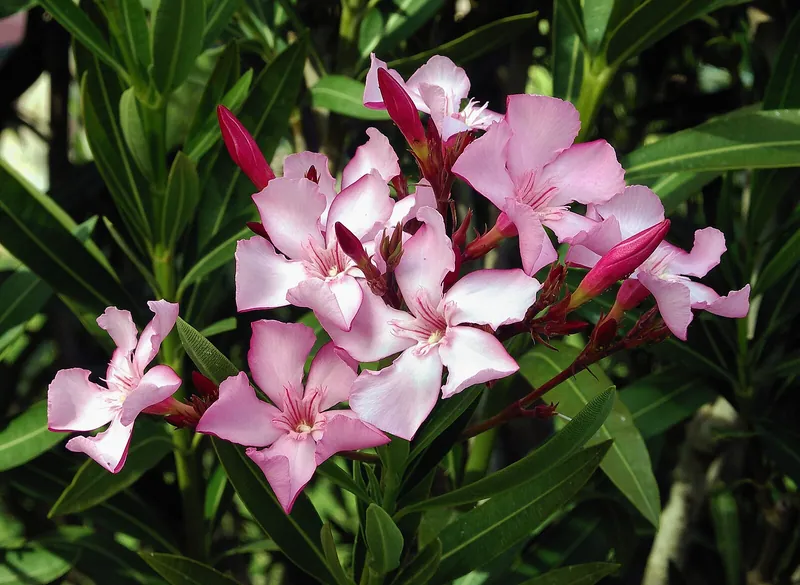

Oleander
Nerium oleander
Also known as: Kaner (Hindi) · Ganneru (Telugu) · Arali (Tamil) · Kanagile (Kannada) · Kanher (Marathi)
Standard horticultural guidance
- ☀️SunFull sun
- 💧WaterLow water
- 🪴SpaceLarge tub
- ⭐CareEasy care
- 📅SeasonAll year
- 🛡️SafetyToxic if eaten
Tough flowering shrub for hot, dry spots; all parts are poisonous – keep away from children and pets.
Plant profile
| Common name | Oleander |
|---|---|
| Botanical name | Nerium oleander |
| Family | Apocynaceae |
| Category | Flowering plants › Flowering shrubs |
| Plant type | Oleander |
| Growth habit | Shrub |
| Origin | Introduced to India – The Mediterranean basin and southwest Asia |
| Sunlight | 6+ hours of direct sun |
| Watering | Check the soil first: water only when the top 5 cm (two finger joints) is dry. In pots that is usually about once a week in summer and every 10–14 days in winter. |
| Soil | Grows in most soils, including poor soil, if drainage is good |
| Where it grows | Terrace, Open ground (backyard / farm) |
| Pot or space needed | 20–24 inch tub or large grow bag |
| Mature size | About 4–10 ft (1.2–3 m) |
| Propagation | Cuttings, air layering |
| Flowering | All year |
| Care difficulty | Easy |
| Child & pet safety | Poisonous if eaten – keep away from children & pets · Pets: Listed as toxic to cats and dogs (ASPCA plant list) |
| Uses | Ornamental, screen |
| Best season | All year · best planted Jun–Aug or Oct–Nov |
Where in India it grows well
| Telangana and Rayalaseema | ✔ Grows well |
|---|---|
| Coastal Andhra Pradesh and Odisha | ✔ Grows well |
| Karnataka plateau (Bengaluru, Mysuru) | ✔ Grows well |
| Tamil Nadu plains | ✔ Grows well |
| Kerala and the Konkan–Malabar coast | ✔ Grows well |
| Maharashtra (Mumbai coast, Pune, Vidarbha) | ✔ Grows well |
| Delhi and the northern plains | ✔ Grows well |
| Hill stations (Ooty, Kodaikanal, Shimla, Darjeeling) | ✖ Not recommended |
About this plant
Where it is grown: Planted along highways and in gardens from Spain and California to India and Australia.
History: Ancient Greeks and Romans grew it in courtyards; its toxicity has been recorded since classical times.
Did you know? It is so drought- and pollution-tolerant that it is a standard highway median plant in many countries.
Cold tolerance: Very cold-tolerant for a flowering shrub – it shrugs off nights near 0°C.
Why grow it: Year-round flowers in the hottest, driest corners where most shrubs fail – for gardens without small children or pets.
Varieties and cultivars (4)
| Name | Type | What it is like | Where it is grown | Status |
|---|---|---|---|---|
| Double Pink | Cultivar group | Double pink flowers | All India | Standard horticultural guidance |
| Single White | Cultivar group | White flowers | All India | Standard horticultural guidance |
| Single Red | Cultivar group | Red flowers | All India | Standard horticultural guidance |
| Petite Salmon | Cultivar | Dwarf oleander with salmon flowers | Nurseries | Needs verification |
Sources and review
- Standard horticultural guidance for Indian conditions – Compiled by SAIPAL from general practice published by ICAR institutes and state agricultural universities
- Toxic and Non-Toxic Plant List – Dogs and Cats – ASPCA Animal Poison Control Center
- Plant photographs and taxonomy pages – Wikimedia Commons
Not yet reviewed by an outside expert. Content prepared by SAIPAL; corrections are welcome through the Feedback page.