 SAIPAL PLANT PROFILER™
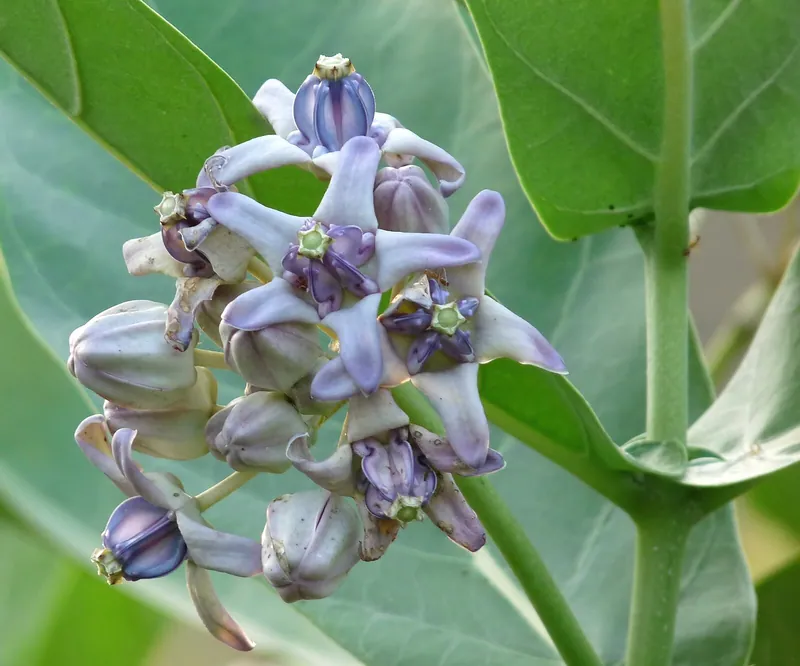

Crown Flower
Calotropis gigantea
Also known as: Calotropis · Aak (Hindi) · Jilledu (Telugu) · Erukku (Tamil) · Ekka (Kannada) · Erukku (Malayalam) · Rui (Marathi)
Standard horticultural guidance
- ☀️SunFull sun
- 💧WaterLow water
- 🪴SpaceLarge tub
- ⭐CareEasy care
- 📅SeasonAll year
- 🛡️SafetyToxic if eaten
Waxy flowers and grey-green leaves; milky sap is poisonous.
Plant profile
| Common name | Crown Flower |
|---|---|
| Botanical name | Calotropis gigantea |
| Family | Apocynaceae |
| Category | Flowering plants › Flowers for worship and garlands |
| Plant type | Calotropis |
| Growth habit | Shrub |
| Origin | Native to India – South and Southeast Asia |
| Sunlight | 6+ hours of direct sun |
| Watering | Check the soil first: water only when the top 5 cm (two finger joints) is dry. In pots that is usually about once a week in summer and every 10–14 days in winter. |
| Soil | Light, sandy, free-draining soil |
| Where it grows | Terrace, Open ground (backyard / farm) |
| Pot or space needed | 20–24 inch tub or large grow bag |
| Mature size | About 4–10 ft (1.2–3 m) |
| Propagation | Seeds, cuttings |
| Flowering | All year |
| Care difficulty | Easy |
| Child & pet safety | Poisonous if eaten – keep away from children & pets |
| Uses | Worship, garlands |
| Best season | All year · best planted Jun–Aug or Oct–Nov |
Where in India it grows well
| Telangana and Rayalaseema | ✔ Grows well |
|---|---|
| Coastal Andhra Pradesh and Odisha | ◐ Possible with extra care |
| Karnataka plateau (Bengaluru, Mysuru) | ✔ Grows well |
| Tamil Nadu plains | ✔ Grows well |
| Kerala and the Konkan–Malabar coast | ◐ Possible with extra care |
| Maharashtra (Mumbai coast, Pune, Vidarbha) | ✔ Grows well |
| Delhi and the northern plains | ✔ Grows well |
| Hill stations (Ooty, Kodaikanal, Shimla, Darjeeling) | ✖ Not recommended |
About this plant
Where it is grown: Grown in India, Southeast Asia and Africa.
History: Used in traditional medicine and decoration.
Did you know? Its leaves feed the caterpillars of the plain tiger butterfly.
Cold tolerance: Tolerates cool nights; protect from frost.
Why grow it: A hardy butterfly host plant for dry gardens.
Sources and review
- Standard horticultural guidance for Indian conditions – Compiled by SAIPAL from general practice published by ICAR institutes and state agricultural universities
- Plant photographs and taxonomy pages – Wikimedia Commons
Not yet reviewed by an outside expert. Content prepared by SAIPAL; corrections are welcome through the Feedback page.