 SAIPAL PLANT PROFILER™
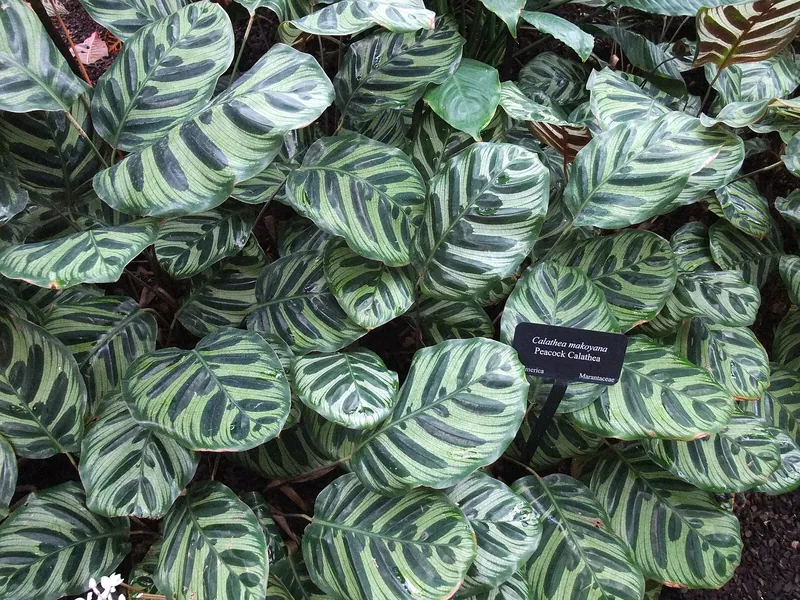

Calathea
Goeppertia spp.
Standard horticultural guidance
- ☀️SunBright indirect
- 💧WaterModerate water
- 🪴SpaceMedium pot
- ⭐CareModerate care
- 📅SeasonAll year
- 🛡️SafetyChild & pet safe
Patterned leaves that fold up at night; needs humidity.
Plant profile
| Common name | Calathea |
|---|---|
| Botanical name | Goeppertia spp. (also listed as Calathea) |
| Family | Marantaceae |
| Category | Indoor and foliage plants › Foliage plants |
| Plant type | Calathea |
| Growth habit | Herbaceous plant |
| Origin | Introduced to India – Tropical Americas, especially Brazil |
| Sunlight | Bright light, no harsh sun |
| Watering | Check the soil first: water when the top 2–3 cm (one finger joint) is dry. In pots that is usually every 2–3 days in summer and once a week in winter. |
| Soil | Rich, moist soil with plenty of organic matter |
| Where it grows | Indoors, Balcony |
| Pot or space needed | 14–18 inch pot or grow bag |
| Mature size | About 2–4 ft (0.6–1.2 m) |
| Propagation | Division |
| Care difficulty | Moderate – regular feeding & pruning |
| Child & pet safety | Safe around children & pets · Pets: Listed as non-toxic to cats and dogs (ASPCA plant list) |
| Uses | Indoor decor |
| Best season | All year · best planted Jun–Aug or Oct–Nov |
Where in India it grows well
| Telangana and Rayalaseema | ◐ Possible with extra care |
|---|---|
| Coastal Andhra Pradesh and Odisha | ✔ Grows well |
| Karnataka plateau (Bengaluru, Mysuru) | ✔ Grows well |
| Tamil Nadu plains | ✔ Grows well |
| Kerala and the Konkan–Malabar coast | ✔ Grows well |
| Maharashtra (Mumbai coast, Pune, Vidarbha) | ✔ Grows well |
| Delhi and the northern plains | ✖ Not recommended |
| Hill stations (Ooty, Kodaikanal, Shimla, Darjeeling) | ✔ Grows well |
About this plant
Where it is grown: Grown worldwide as a houseplant.
History: Its leaves have been used for wrapping food in South America.
Did you know? Its leaves fold up at night – it is a "prayer plant" relative.
Cold tolerance: Keep above 15°C.
Why grow it: Stunning patterned leaves that move with the day.
Varieties and cultivars (10)
| Name | Type | What it is like | Where it is grown | Status |
|---|---|---|---|---|
| Calathea orbifolia (Goeppertia orbifolia) | Cultivar group | Large round leaves with silver bands | Nurseries | Standard horticultural guidance |
| Medallion (G. roseopicta) | Cultivar | Round leaves with feathered silver pattern | Nurseries | Standard horticultural guidance |
| Rattlesnake (G. insignis) | Cultivar group | Wavy, long leaves with dark spots | Nurseries | Standard horticultural guidance |
| Zebrina (G. zebrina) | Cultivar group | Velvety zebra-striped leaves | Nurseries | Standard horticultural guidance |
| White Fusion | Cultivar | Leaves splashed white and lilac | Nurseries | Standard horticultural guidance |
| Pinstripe (G. ornata) | Cultivar group | Pink pinstripes on dark leaves | Nurseries | Standard horticultural guidance |
| Network (G. kegeljanii) | Cultivar group | Mosaic-patterned leaves | Nurseries | Needs verification |
| Freddie (G. concinna) | Cultivar group | Light green with dark green stripes | Nurseries | Needs verification |
| Calathea crocata (Eternal flame) | Cultivar group | Orange flower bracts – a related species | Nurseries | Standard horticultural guidance |
| Calathea 'Dottie' | Cultivar | Dark leaves with pink lines | Nurseries | Needs verification |
Sources and review
- Standard horticultural guidance for Indian conditions – Compiled by SAIPAL from general practice published by ICAR institutes and state agricultural universities
- Toxic and Non-Toxic Plant List – Dogs and Cats – ASPCA Animal Poison Control Center
- Plant photographs and taxonomy pages – Wikimedia Commons
Not yet reviewed by an outside expert. Content prepared by SAIPAL; corrections are welcome through the Feedback page.