 SAIPAL PLANT PROFILER™
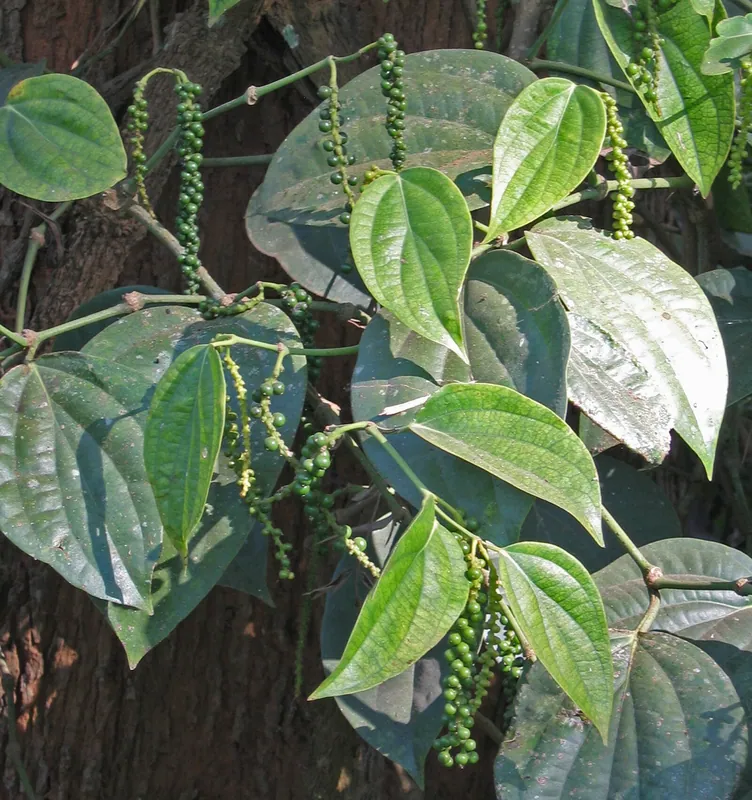

Black Pepper Vine
Piper nigrum
Also known as: Kali mirch (Hindi) · Miriyalu (Telugu) · Milagu (Tamil) · Menasu (Kannada) · Kurumulaku (Malayalam) · Kali miri (Marathi)
Standard horticultural guidance
- ☀️SunPart sun
- 💧WaterModerate water
- 🪴SpaceLarge tub
- ⭐CareModerate care
- 📅SeasonAll year
- 🛡️SafetyNot yet verified
Climbs a tree trunk in humid shade.
Plant profile
| Common name | Black Pepper Vine |
|---|---|
| Botanical name | Piper nigrum |
| Family | Piperaceae |
| Category | Herbs, spices and medicinal plants › Plantation spices |
| Plant type | Black pepper |
| Growth habit | Climber |
| Origin | Native to India – The Western Ghats of southern India |
| Sunlight | 2–4 hours of gentle sun |
| Watering | Check the soil first: water when the top 2–3 cm (one finger joint) is dry. In pots that is usually every 2–3 days in summer and once a week in winter. |
| Soil | Rich, moist soil with plenty of organic matter |
| Where it grows | Open ground (backyard / farm) |
| Pot or space needed | 20–24 inch tub or large grow bag |
| Mature size | About 4–10 ft (1.2–3 m) |
| Propagation | Cuttings |
| Flowering | May–Jul |
| Fruiting / harvest | Dec–Mar |
| Care difficulty | Moderate – regular feeding & pruning |
| Child & pet safety | No known toxicity, but not yet verified against a toxicity list – keep it away from small children and pets |
| Uses | Spice |
| Best season | All year · best planted Jun–Aug or Oct–Nov |
Where in India it grows well
| Telangana and Rayalaseema | ◐ Possible with extra care |
|---|---|
| Coastal Andhra Pradesh and Odisha | ✔ Grows well |
| Karnataka plateau (Bengaluru, Mysuru) | ✔ Grows well |
| Tamil Nadu plains | ✔ Grows well |
| Kerala and the Konkan–Malabar coast | ✔ Grows well |
| Maharashtra (Mumbai coast, Pune, Vidarbha) | ✔ Grows well |
| Delhi and the northern plains | ✖ Not recommended |
| Hill stations (Ooty, Kodaikanal, Shimla, Darjeeling) | ✖ Not recommended |
About this plant
Where it is grown: Grown in Vietnam, Indonesia, India, Brazil and Sri Lanka.
History: Called "black gold" – it was traded along ancient spice routes.
Did you know? Black, white and green pepper all come from the same plant.
Cold tolerance: Prefers warmth; protect from cold.
Why grow it: Your own supply of the world's most traded spice.
Varieties and cultivars (7)
| Name | Type | What it is like | Where it is grown | Status |
|---|---|---|---|---|
| Panniyur 1 | Hybrid | First pepper hybrid; long spikes | Kerala | Standard horticultural guidance |
| Karimunda | Cultivar | Popular traditional pepper | Kerala | Standard horticultural guidance |
| Sreekara | Released variety | IISR high-yield variety | Kerala | Standard horticultural guidance |
| Subhakara | Released variety | IISR variety | Kerala | Standard horticultural guidance |
| Thevam | Released variety | IISR variety tolerant to foot rot | Kerala | Needs verification |
| Bush pepper | Cultivar group | Pepper rooted from fruiting branches; stays a small bush for pots | Kerala nurseries | Standard horticultural guidance |
| Malabar Pepper | Cultivar group | GI-tagged pepper of the Malabar coast | Kerala | Standard horticultural guidance |
Sources and review
- Standard horticultural guidance for Indian conditions – Compiled by SAIPAL from general practice published by ICAR institutes and state agricultural universities
- Plant photographs and taxonomy pages – Wikimedia Commons
Not yet reviewed by an outside expert. Content prepared by SAIPAL; corrections are welcome through the Feedback page.