 SAIPAL PLANT PROFILER™
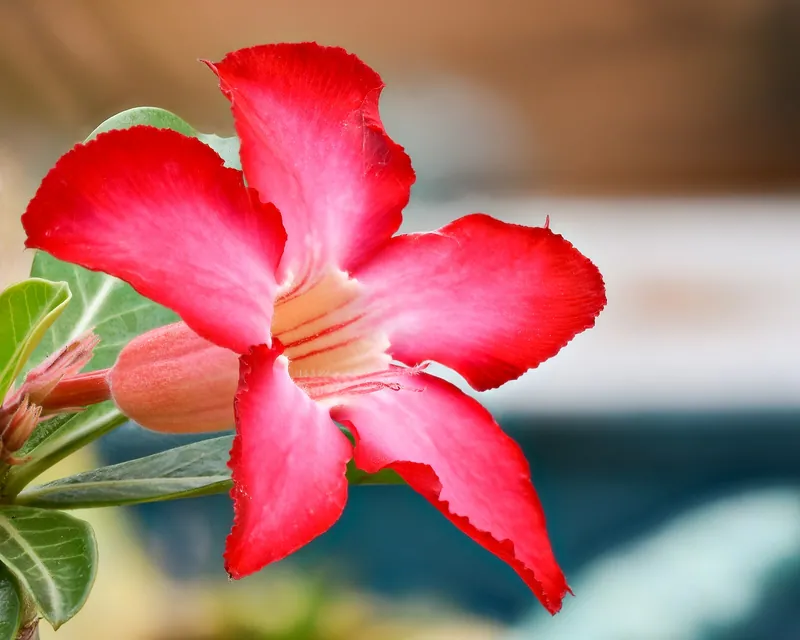

Adenium
Adenium obesum
Also known as: Desert Rose
Standard horticultural guidance
- ☀️SunFull sun
- 💧WaterLow water
- 🪴SpaceSmall pot
- ⭐CareEasy care
- 📅SeasonAll year
- 🛡️SafetyToxic if eaten
Swollen-trunk flowering plant for hot terraces or the sunniest window; sap is poisonous.
Plant profile
| Common name | Adenium |
|---|---|
| Botanical name | Adenium obesum |
| Family | Apocynaceae |
| Category | Succulents and cacti › Caudiciforms |
| Plant type | Adenium |
| Growth habit | Succulent |
| Origin | Introduced to India – Arabia and Eastern Africa |
| Sunlight | 6+ hours of direct sun |
| Watering | Check the soil first: water only when the top 5 cm (two finger joints) is dry. In pots that is usually every 10–14 days in summer and every 3–4 weeks in winter; almost none in the monsoon. |
| Soil | Gritty, very free-draining mix (sand, grit, little compost) |
| Where it grows | Indoors, Balcony, Terrace |
| Pot or space needed | 10–12 inch pot |
| Mature size | About 1–2 ft (30–60 cm) |
| Propagation | Seeds, grafting, cuttings |
| Flowering | Nov–Jun |
| Care difficulty | Easy |
| Child & pet safety | Poisonous if eaten – keep away from children & pets · Pets: Listed as toxic to cats and dogs (ASPCA plant list) |
| Uses | Ornamental, bonsai |
| Best season | All year · best planted Jun–Aug or Oct–Nov |
Where in India it grows well
| Telangana and Rayalaseema | ✔ Grows well |
|---|---|
| Coastal Andhra Pradesh and Odisha | ✖ Not recommended |
| Karnataka plateau (Bengaluru, Mysuru) | ◐ Possible with extra care |
| Tamil Nadu plains | ◐ Possible with extra care |
| Kerala and the Konkan–Malabar coast | ✖ Not recommended |
| Maharashtra (Mumbai coast, Pune, Vidarbha) | ✔ Grows well |
| Delhi and the northern plains | ✔ Grows well |
| Hill stations (Ooty, Kodaikanal, Shimla, Darjeeling) | ✖ Not recommended |
About this plant
Where it is grown: Grown worldwide; very popular in Thailand and India.
History: Thai growers have developed thousands of hybrids.
Did you know? Its swollen trunk stores water.
Cold tolerance: Keep dry and above 10°C in winter.
Why grow it: A sculptural flowering plant for hot, sunny spots. (Sap is poisonous.)
Varieties and cultivars (7)
| Name | Type | What it is like | Where it is grown | Status |
|---|---|---|---|---|
| Arabicum (Thai Socotranum types) | Cultivar group | Thick, squat caudex prized for bonsai-like plants | Nurseries | Standard horticultural guidance |
| Obesum (common) | Cultivar group | The common pink-red desert rose | All India | Standard horticultural guidance |
| Double-petal grafts | Cultivar group | Grafted plants with double or triple flowers | Nurseries | Standard horticultural guidance |
| Black Ruby (dark) | Cultivar group | Nursery name for very dark red flowers | Nurseries | Needs verification |
| Multi-colour grafts | Cultivar group | Several flower colours grafted on one plant | Nurseries | Standard horticultural guidance |
| Adenium 'Black Rose' | Cultivar | Very dark red double flowers | Nurseries | Needs verification |
| Adenium 'Hong Kong Yellow' | Cultivar | Yellow-centred flowers | Nurseries | Needs verification |
Sources and review
- Standard horticultural guidance for Indian conditions – Compiled by SAIPAL from general practice published by ICAR institutes and state agricultural universities
- Toxic and Non-Toxic Plant List – Dogs and Cats – ASPCA Animal Poison Control Center
- Plant photographs and taxonomy pages – Wikimedia Commons
Not yet reviewed by an outside expert. Content prepared by SAIPAL; corrections are welcome through the Feedback page.